Weathering the Storm: Capy Chino’s Guide to a Calm, Sensory-Safe Hurricane Season
Hello, friends! Capy Chino here, your friendly neighborhood capybara and Hope For Three mascot. If there is one thing we capybaras are famous for, it is staying absolutely calm, relaxed, and chill even when the world around us gets a little chaotic. We love water, but when hurricane season rolls around, the big storms can bring a lot of noise, sudden changes, and disruptions that aren’t relaxing at all.
For our amazing friends on the autism spectrum, a hurricane isn’t just about bad weather; it is a giant wave of sensory overload and broken routines. Research indicates that families navigating neurodivergent needs experience significantly higher stress during disasters and evacuations (Kelly & Danzi, 2025).
But don’t worry! Capy Chino has put together a step-by-step guide to help caregivers create a peaceful, safe harbor before the dark clouds roll in. Let’s look at how we can handle the three biggest storm hurdles together.
The Three Big Storm Disruptions (And How to Soften Them)The Three Big Storm Disruptions (And How to Soften Them)
To keep things steady, it helps to understand exactly what makes a storm so tough for an autistic individual. Once we map out the triggers, we can handle them like a pro.
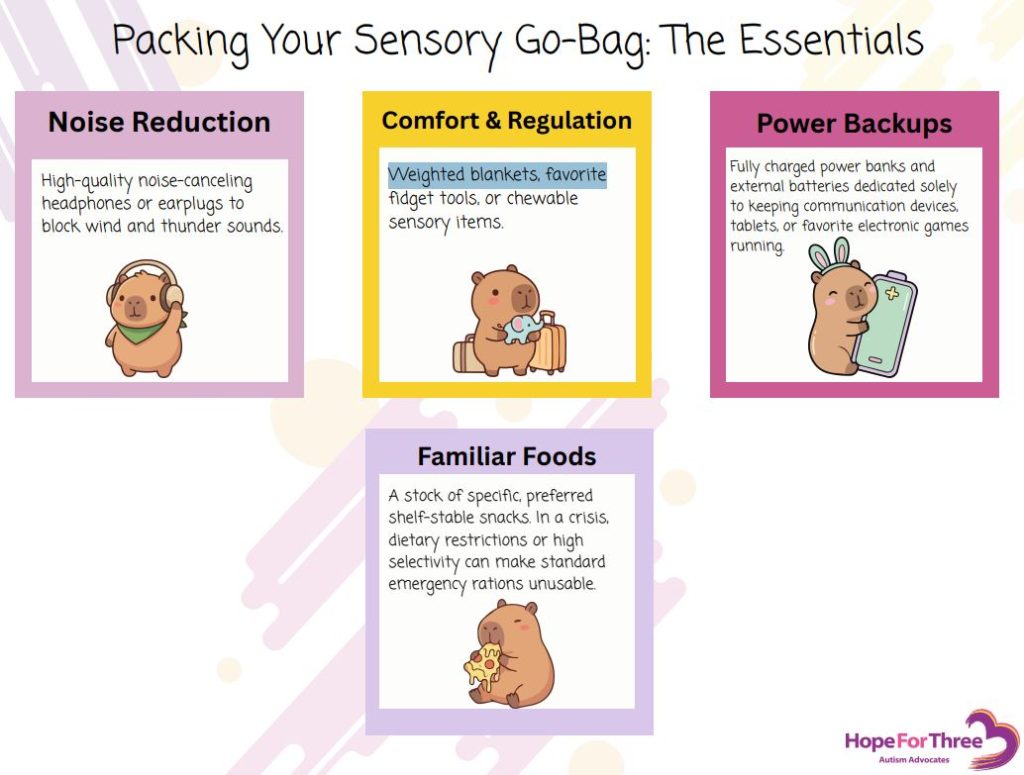
Packing Your Sensory Go-Bag: The EssentialsPacking Your Sensory Go-Bag: The Essentials
When a storm hits, a standard emergency kit with just water and flashlights isn’t quite enough for neurodivergent members in a household. We need a specialized toolkit to keep nervous systems grounded! Here is exactly what to pack in your dedicated sensory bag:
Capy Chino’s Step-by-Step Preparedness Plan
We can’t stop the wind from blowing, but we can build a strong safety net of comfort and predictability. Here is how you can prepare your home and your autistic loved one(s):
1. Pre-Teach the Storm with Visual Stories:
Do this on a sunny day. Don’t wait for the weather reports to get serious. Sit down together and read social narratives or visual stories that explain what a hurricane is, what a power outage looks like, and what the family’s safety plan is. Practice sitting in your safe room (like an interior bathroom) with flashlights, turning it into a cozy, low-stress practice game.
2. Assemble Your Sensory Go-Bag:
Pack this ahead of time. Gather all the items from our checklist above and store them in a waterproof backpack. Keep this bag in an easily accessible spot near your main emergency supplies so you can grab it instantly if you need to move to a safe room or evacuate.
3. Create Visual Communication Tools:
Keep these printed and ready. Print out simple “First-Then” picture cards (PECS) to use if the power goes out or stress levels make talking difficult (e.g., First: Wear headphones. Then: Eat a snack). Also, print out an Emergency Information Form that details your loved one’s specific triggers, calming strategies, and medication list in case you need to speak with emergency personnel (Hipper et al., 2018).
Staying Put vs. Heading Out: Finding the Calmest Path
Choosing whether to shelter at home or evacuate is a massive decision. Studies confirm that families of children with complex health and developmental needs experience significantly greater barriers and anxiety when forced to leave their familiar home environments (Kelly & Danzi, 2025).
If You Shelter at Home: Control the Micro-Environment
If you are safe to stay home, focus on keeping the immediate surroundings as familiar as possible. If the power goes out, use battery-powered fans to keep the room cool, as heat spikes can exacerbate distress (Mehta et al., 2024). Stick to regular mealtimes and bedtime routines as closely as humanly possible, even if you are eating by flashlight!
If You Must Evacuate: Skip the General Public Shelters
Traditional emergency shelters are bright, loud, crowded, and unpredictable, the exact opposite of a capybara vibe. If you must evacuate, try to plan for a quiet hotel room, a trusted family member’s house, or an official “Special Needs” medical shelter.
While you are navigating an evacuation or an unfamiliar environment, having an official safety backup in place can bring immense peace of mind. This is where programs like the “Take Me Home” Database Registry become a true lifesaver.
Developed specifically for individuals who may have difficulty communicating or tend to wander or elope when overwhelmed, this voluntary program places critical information directly into the hands of local law enforcement.
Capy’s Safety Tip: Before storm season ramps up, check with your local police department or sheriff’s office to see if they utilize the “Take Me Home” framework or a similar Special Needs Registry. It takes just a few minutes to register, but it creates an invaluable safety net when routines are completely upended.
The Calm After the Storm
Remember, the challenge doesn’t end the moment the rain stops. The days following a storm bring loud chainsaws, messy yards, and broken routines. It is completely natural to see an increase in emotional meltdowns or behavioral changes during the cleanup phase. This is just a normal reaction to survival stress (Kelly & Danzi, 2025).
Be gentle with your loved one, lean heavily on your visual schedules, and take things one quiet step at a time. By planning with a sensory-first mindset, you can protect your family’s safety and peace of mind. Stay safe, cozy, and let’s channel our inner capybara this season!
References
Doğan Aslan, S. (2024). Exposure to the earthquake with a child with autism: A qualitative study on parenting experiences. International Journal of Disaster Risk Reduction, 113, 104850. https://doi.org/10.1016/j.ijdrr.2024.104850
Hipper, T. J., Davis, R., Massey, P. M., Turchi, R. M., Lubell, K. M., Pechta, L. E., Rose, D. A., Wolkin, A., Briseño, L., Franks, J. L., & Chernak, E. (2018). Disaster information needs of families of children with special healthcare needs: A scoping review. Health Security, 16(1), 178–192. https://doi.org/10.1089/hs.2018.0007
Kelly, J. T., & Danzi, B. A. (2025). Complex health needs in hurricane-affected youth and their families: Barriers, vulnerabilities, and mental health outcomes. Research on Child and Adolescent Psychopathology. https://doi.org/10.1007/s10802-024-01279-6
Mehta, M. M., Johnson, E. A., Ratnakaran, B., Seritan, I., & Seritan, A. L. (2024). Climate change and aging: Implications for psychiatric care. Current Psychiatry Reports, 26(1), 499–513. https://doi.org/10.1007/s11920-024-01525-0
Mailing address:
4771 Sweetwater Blvd., #358
Sugar Land, TX 77479